What if your AI did not just wait for your prompts, but worked quietly in the background around the clock—managing your calendar, updating slide decks, and resolving code bugs before you even woke up?
Welcome to the era of agentic AI. OpenAI DevDay 2026 presented a major shift from conversational tools toward autonomous agents that collaborate, research, and build alongside us.
Meet Your Dot and ChatGPT Space
Dots are not standard chatbots. Think of them as always-on virtual chiefs of staff. Powered by the Astra model, a Dot learns how you work over time and where you want to focus your attention. It can monitor bug reports, test code in draft pull requests, book plane tickets, or coordinate with vendors when plans go awry.
Instead of telling your AI every individual step, you can delegate ambitious, multi-step projects. Dots have their own isolated cloud computers where they can write and test code. In the future, users will also be able to call them directly or exchange text messages with them.
OpenAI introduced ChatGPT Space to make this collaboration seamless. It is a shared workspace where humans and Dots interact on the same page. A team can tag a Dot to track project dependencies, generate dynamic bar charts, or pull information from Slack channels in real time. For larger organizations, Specialist Dots can act as dedicated virtual teammates for intensive workflows.
Supercharged Models: GPT 6.1 sol, UltraFast, and the Decisions API
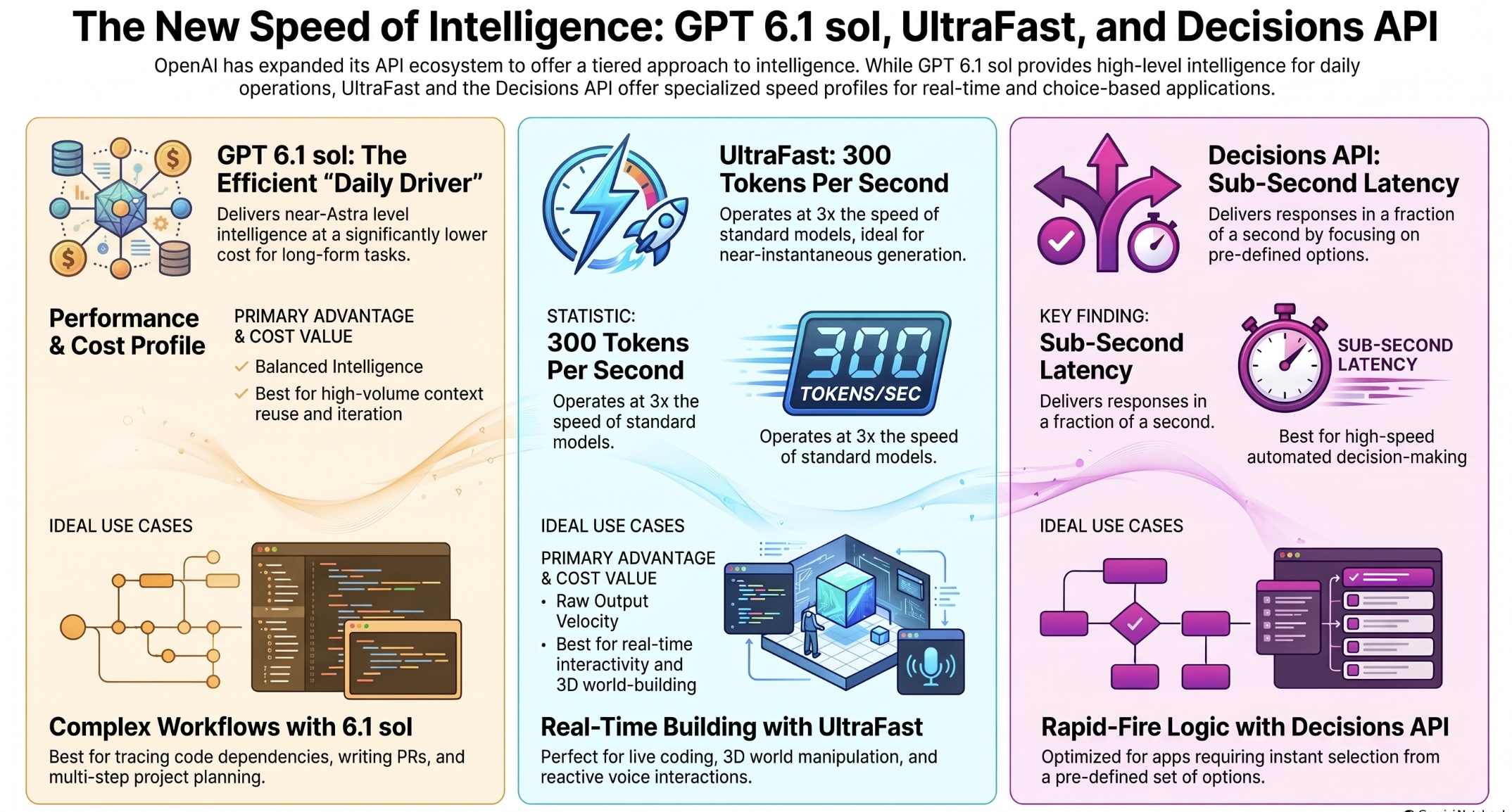
OpenAI expanded its model lineup around three core measures: intelligence, speed, and cost. Each offering targets a different kind of work.
Intelligence and value
GPT 6.1 sol
Near-frontier intelligence at a lower cost for long-running tasks, context reuse, iteration, and complex project workflows.
Raw speed
UltraFast
Up to 300 tokens per second for live coding, real-time interaction, and near-instantaneous generation.
Structured choices
Decisions API
Sub-second responses for applications that select from a predefined set of options.
GPT 6.1 sol: The efficient daily driver
GPT 6.1 sol offers near-frontier intelligence at a fraction of the cost. It is designed for long tasks, making it more economical to reuse context, iterate on solutions, trace code dependencies, write pull requests, and plan multi-step projects.
UltraFast: Real-time generation
UltraFast produces up to 300 tokens per second across the API, ChatGPT, and Codex. Its raw output velocity is suited to real-time interactivity, live coding, reactive voice experiences, and the creation or manipulation of complex 3D environments.
Decisions API: Sub-second structured decisions
The Decisions API focuses the model on a predefined set of options to deliver structured responses with sub-second latency. This makes it useful for automated decision workflows and other applications where rapid, constrained selection matters more than open-ended generation.
The Rise of the AI Research Intern
In 2025, OpenAI predicted that it would achieve the first autonomous AI research intern within a year. That milestone is now presented as a reality.
Advanced post-training models excel at mathematics, coding, and computer use. Rather than only assisting researchers, they can run in continuous loops to train and improve future AI systems, refine safety filters, and reduce mistakes while navigating desktop applications.
This virtual intern now carries out more than one-third of day-long research tasks without human intervention. The impact is already extending beyond software: these models have helped solve more than 100 longstanding mathematics problems, accelerate the synthesis of new antibiotics, and advance robotic manufacturing.
The Next-Generation Developer Ecosystem
OpenAI is making the tools it uses internally to build ChatGPT and Codex available to developers.
Codex in the Cloud
Developers can launch ambitious, cross-device tasks. A coding job can begin on a phone and continue in the cloud while Codex works through a complex revision, such as rewriting an entire backend in Rust.
Computer Use API
Agents can interact directly with computers by opening browsers, navigating pages, and carrying out workflows that resemble the work of a manual software tester.
OpenAI Private Tension
This secure framework combines frontier-model capabilities with zero-data retention. Enterprise customer content is not stored on OpenAI servers, establishing a stronger standard for private AI workloads.
Monetization and Distribution
With Sign in with ChatGPT, people can access third-party applications using their existing ChatGPT plan tokens. This can reduce API-hosting costs for developers and make new software easier for consumers to try.
Key Takeaways
- Dots and Space: AI is moving from passive chatbots to always-on agents that run on cloud computers and collaborate directly with teams.
- Advanced models: GPT 6.1 sol focuses on cost-effective intelligence, UltraFast on high-speed generation, and the Decisions API on near-instant constrained choices.
- Autonomous researchers: AI research agents can complete a growing share of long technical tasks while accelerating progress in mathematics, chemistry, and robotics.
- Developer cloud upgrades: Codex in the Cloud, the Computer Use API, and Private Tension extend agentic capabilities while addressing workflow and privacy needs.
- Simplified distribution: Sign in with ChatGPT gives third-party developers a new way to reach users without requiring them to manage separate model access.