
Did you know that giving an AI coding agent a short prompt like “create a login page” can generate technical debt faster than an entire team of human developers?
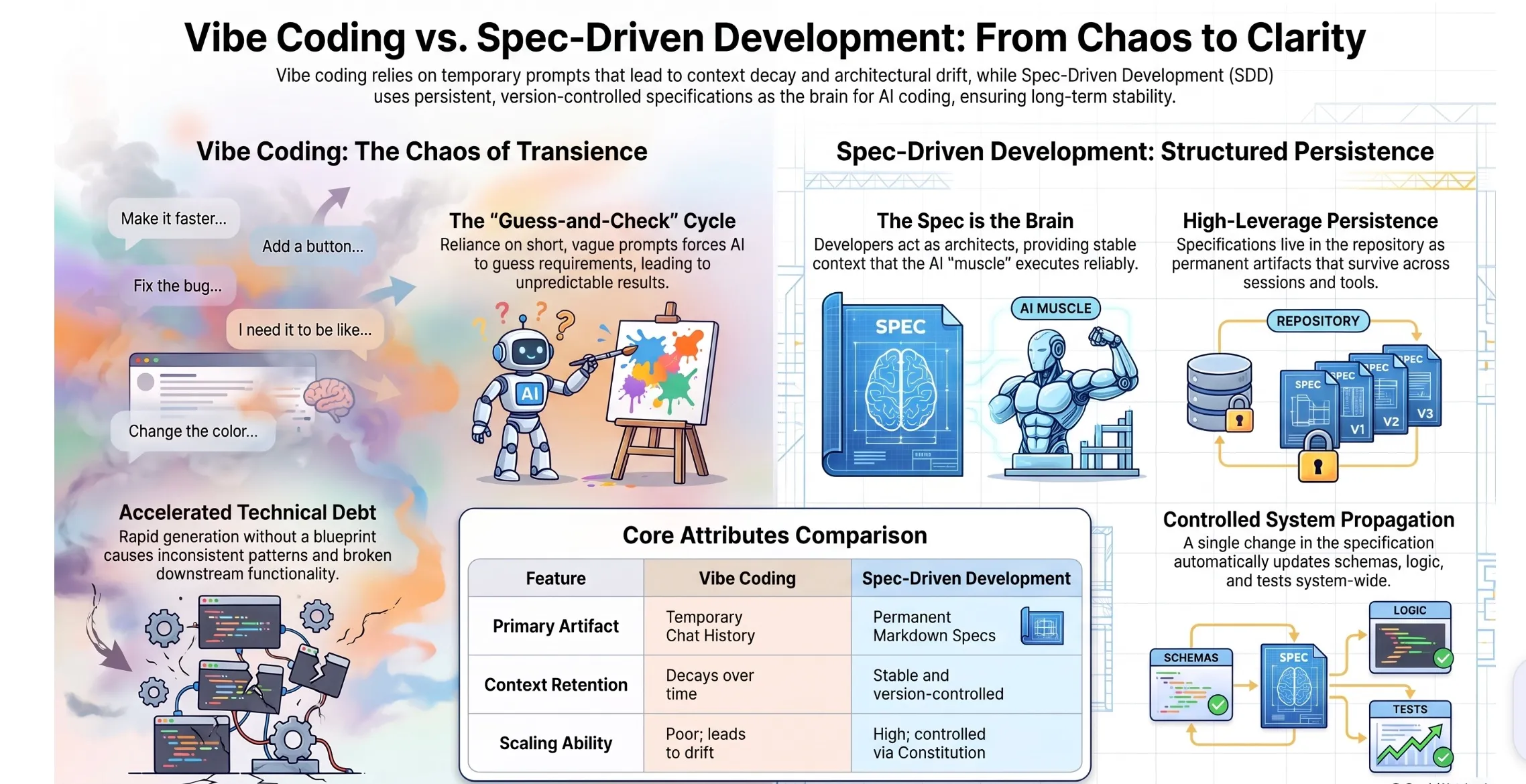
While vibe coding (building software through quick prompts and trial and error) feels like magic for tiny experiments, it quickly falls apart on serious production projects. To build scalable, maintainable applications with AI, we must shift from prompting-first to spec-first.
Welcome to Spec-Driven Development (SDD), where the specification becomes the shared brain and the AI agent provides the execution muscle.
The Pitfalls of Vibe Coding
Imagine cooking a complex five-course meal without a recipe: throwing ingredients into a pot, tasting the result, and trying to correct the flavor as you go. This is vibe coding. You give an AI agent a short instruction, review the output, explain what is wrong, and repeat the loop until you are satisfied.
Vibe coding works beautifully for small prototypes, but it fails to scale for several reasons:
Context Decay
Chat conversations become extremely long. As the context window fills, the agent gradually loses earlier decisions, architectural constraints, and custom error formats.
Architectural Drift
Without a stable reference point, the agent may make technically valid but project-incorrect decisions, such as mixing REST and GraphQL patterns in one repository.
Hidden Technical Debt
Rapidly generating hundreds of lines without fully understanding them can introduce security vulnerabilities, dependency conflicts, and forgotten edge cases.
What Is Spec-Driven Development?
Spec-Driven Development is an approach in which you author a detailed, unambiguous specification of what needs to be built before any code is generated. Think of it as a blueprint.
One of the most powerful concepts in SDD is separating the specification from the implementation:
What and why
The Specification
Defines what should be built and why. For example: “Users must be able to sign in securely using an email address and password.”
How
The Implementation
Defines the technical approach, for example whether the application uses SQLite with Prisma ORM or MongoDB.
Keeping these concerns separate creates leverage. If you decide to move from SQLite to MongoDB, you update the technical plan and let the coding agent identify and propagate the necessary changes across schemas, logic, tests, and other affected code.
The architect and builder analogy
In this workflow, you act as the architect, defining the dimensions, materials, and safety constraints. The AI agent acts as a highly capable builder, handling the construction work under your supervision.
The Project Constitution
Before writing individual features, you need a solid foundation. The Project Constitution is the high-level, stable source of truth that governs the repository and prevents AI agents from making unsupported assumptions.
A robust Project Constitution has three pillars:
The Mission
Why does the project exist? Who is the target audience, and what is explicitly in or out of scope?
The Tech Stack
Which languages, databases, testing frameworks, and architectural patterns will the project use?
The Roadmap
Which feature phases are planned? The roadmap is a living document that guides overall progress.
The SDD Feature Development Loop
Once the Constitution is established, development proceeds in repeatable cycles. Rather than attempting to generate an entire project at once, you build incrementally through four steps:
-
Specification
Describe the feature’s behavior, requirements, and edge cases. Instead of saying “add login,” specify that passwords travel over HTTPS, session timeouts display a warning, and accounts lock after five failed attempts.
-
Implementation
The AI coding agent reads the specification, inspects the codebase, prepares a step-by-step design, and then writes the code and tests.
-
Validation
Verify that the result matches the specification through unit tests, type checking, linting, and visual UI checks. Code that compiles is not necessarily correct if it misses the business intent.
-
Replanning
Review what you learned and whether the requirements changed. Update the Constitution or future specifications so each cycle improves the next one.
SDD in the Real World: OpenSpec and Spec Kit
Two prominent open-source toolkits can help you apply Spec-Driven Development on your local machine.
Flexible and lightweight
OpenSpec
OpenSpec, by Fission-AI, uses an artifact-guided workflow across more than 30 AI assistants, including Cursor, Claude Code, and Copilot.
/opsx:exploreto brainstorm/opsx:proposeto generate specifications and checklists/opsx:applyto implement the proposed work
Structured and sequential
Spec Kit
Spec Kit, by GitHub, provides a Python-based toolkit with explicit checkpoints that move work through a disciplined sequence.
/speckit-specify/speckit-plan/speckit-tasks/speckit-implement/speckit-converge
Greenfield versus brownfield projects
- Greenfield projects: Start from scratch by working with an AI assistant to create the Constitution and initial specifications.
- Brownfield projects: Ask the coding agent to inspect the existing folder structure, dependencies, and patterns to establish a baseline Constitution grounded in the current codebase.
Protocols for Agent Independence
The AI ecosystem changes rapidly. Today’s preferred coding agent or model may be replaced by a stronger one within months, so specifications should remain agent-independent.
Several open standards support portable workflows:
Model Context Protocol (MCP)
A standardized way for AI models to connect securely to external data sources, tools, and databases beyond the local code repository.
Agent Client Protocol (ACP)
A protocol for connecting AI coding agents with development clients such as IDEs and code editors, supporting richer editing interactions, planning modes, and next-edit suggestions.
Building around structured Markdown specifications instead of chaotic chat prompts makes the work easier to transfer between tools. The agent is the muscle, but the specification remains the brain.
Key takeaways
Spec-Driven Development changes our responsibility in the AI era. Instead of manually typing every line of code, we focus on communicating intent, managing architecture, and validating results.
- Intent is the new source of truth: Specifications act as executable contracts that guide coding agents with minimal ambiguity.
- Establish a Project Constitution: Define the Mission, Tech Stack, and Roadmap early to give the codebase a permanent anchor.
- Practice disciplined iteration: Use specification, implementation, validation, and replanning to scale without accumulating uncontrolled technical debt.
- Keep workflows agent-independent: Write specifications in clean Markdown and use standards such as MCP and ACP so the project can outlive changing AI tools.